ECM Records
★★★★☆
By Max Millar
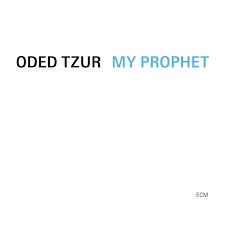
When Oded Tzur first emerged on the international jazz scene, it was clear that this Israeli saxophonist was playing by his own rules. Tzur’s work had always been distinguished by his deeply spiritual approach to music, drawing from the ancient traditions of Indian classical music and seamlessly blending them with jazz’s improvisatory language. With each release, his sound evolved into something even more distinct, with his innovative technique—a microtonal approach to the saxophone—allowing him to stretch the instrument’s expressive capabilities in ways that few musicians have attempted before. His latest album, My Prophet, marks another striking chapter in this journey, demonstrating not just a refined musical technique but a profound deepening of his voice as an artist.
Tzur’s distinctive sound is rooted in a technique he calls Middle Path, which extends the saxophone’s microtonal capacity. Inspired by the playing of Indian maestro Hariprasad Chaurasia, whose bansuri (bamboo flute) mastery includes the ability to move between microtones with fluidity, Tzur began to reimagine the saxophone’s potential. While the Western music tradition has historically dealt in fixed pitches and semitone intervals, Tzur’s technique allows for far more subtle variations—sliding between pitches, bending notes in a way that evokes the tonal flexibility of Indian instruments like the bansuri, sitar, and veena. These microtonal shifts breathe new life into the saxophone, turning it into a vessel capable of moving between emotional states with a new depth of resonance.
On My Prophet, Tzur’s use of Middle Path reaches new heights. The album presents an entirely new level of sonic intimacy, as the saxophone weaves intricate melodic lines, with Tzur bending and shaping every note, creating a dynamic range of tones that shifts with remarkable fluidity. In his previous ECM releases, like Like a Great River (2016), this approach was already evident, but My Prophet showcases it with greater clarity and precision. The album is less a collection of individual compositions and more a thematic journey, one in which Tzur meditates on both the physical and spiritual worlds—perhaps most notably, a reflection of his experiences living in New York, a city teeming with contrasts, contradictions, and possibilities.
The title My Prophet evokes a sense of personal revelation, and the music that unfolds throughout the album resonates with an almost sacred aura. Tzur’s mastery of microtones is complemented by the rich textures of his ensemble—veteran bassist Matt Penman, drummer Nasheet Waits, and pianist Nitai Hershkovits (who also worked with Tzur on his earlier projects) form a cohesive, almost meditative unit. The rhythm section’s interplay with Tzur’s saxophone is subtle yet deeply engaging, creating a musical space where silence and sound coexist with equal power. Tzur’s sound is less about complexity and more about nuance—each note feels deliberate, yet open to the infinite possibilities of jazz improvisation.
The album opens with the title track, “My Prophet,” which encapsulates Tzur’s technique at its most evocative. The piece begins with a long, sustained note on the saxophone that seems to bend and twist in space. The rhythmic pulse slowly enters, with Waits’ delicate brushwork setting the pace for the saxophone’s melodic line. The influence of Indian classical music is palpable here, as Tzur allows the note to slide in and out of focus, creating a mood of mystical searching. His saxophone no longer feels like a Western instrument but a voice steeped in a spiritual tradition, rich with the colors of ancient Indian ragas.
Tracks like “The River,” with its shimmering, elongated phrases, feel like meditations on time itself—slowing down and stretching, yet never becoming stagnant. Meanwhile, “Nirvana,” a standout track, shows Tzur’s intricate relationship with improvisation. The saxophone alternates between delicate melodic lines and intense bursts of sound, underscoring Tzur’s ability to bring together the disparate worlds of jazz and Indian music without losing either’s essence. His technique of sliding between microtones creates an emotional depth that’s as resonant as any harmonic structure.
When comparing My Prophet to Tzur’s previous ECM releases, particularly Like a Great River and Dharma (2019), one notices a continued evolution of his sound. Dharma was already a clear statement of his fusion of jazz and Indian tonalities, but My Prophet feels more intimate, more reflective. Tzur’s saxophone has become even more expressive, as though he’s now speaking from a deeper place of understanding, one that transcends genre. His ability to integrate microtonal inflections into jazz improvisation has reached its most mature stage here, suggesting that Tzur’s musical voice has solidified into something that feels both timeless and of the moment.
While his earlier ECM work often embraced the vastness of sound, My Prophet feels more inward, a search for clarity through simplicity. The compositions, though intricate, don’t draw attention to themselves; rather, they allow the interplay between melody, rhythm, and space to become the focus. Tzur’s saxophone technique is more than just a vehicle for sound—it’s a means of spiritual expression. The result is an album that feels deeply meditative, an exploration of both the outer world of jazz and the inner realm of the soul.
In essence, My Prophet is a culmination of Tzur’s singular vision. It brings together his profound understanding of Indian music with his jazz sensibility to create something wholly unique. The saxophone, under his fingers, becomes a tool for transcendence—a bridge between two worlds of music that, when combined, offer a sound more compelling than either could produce alone. Tzur has truly found a Middle Path, and on My Prophet, he invites us to walk it with him.
 Max Millar Music
Leave a comment