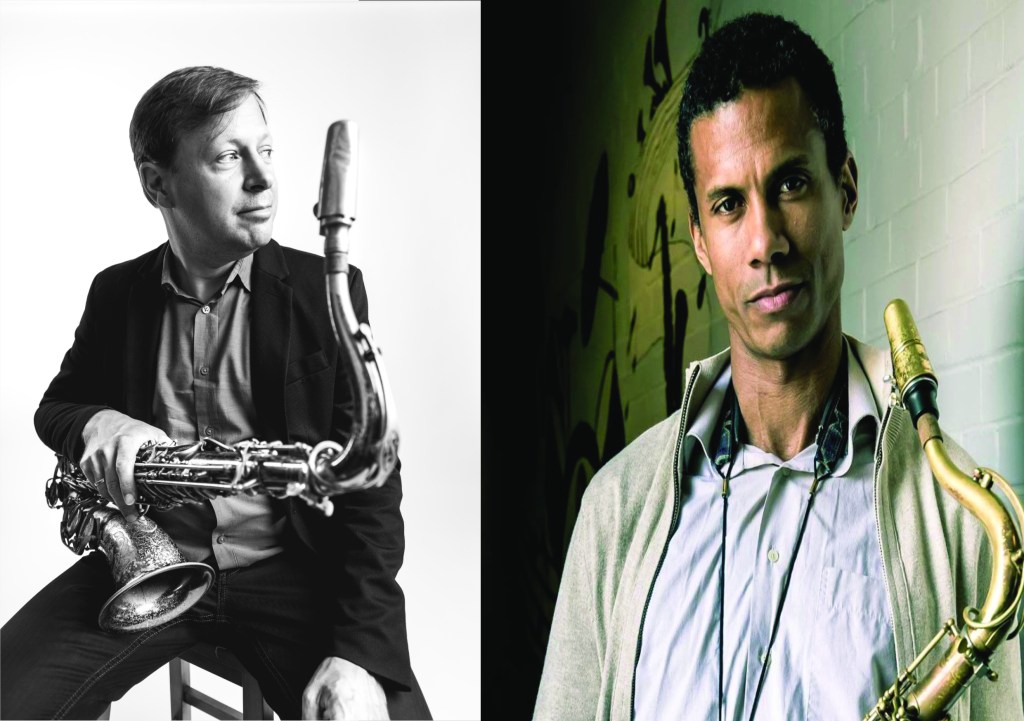
Chris Potter and Mark Turner: Two Titans of the Tenor Saxophone
When discussing modern jazz saxophone, the names Chris Potter and Mark Turner loom large, their styles as distinct as their paths to prominence. Both emerged in the 1990s and quickly established themselves as paragons of technical mastery and creative ingenuity. Yet, their approaches to improvisation, their artistic priorities, and the influences they’ve passed on to subsequent generations could hardly be more different. Together, they’ve reshaped the landscape of jazz saxophone, setting a dual template for innovation that continues to inspire younger players.
Chris Potter: Virtuosity and the Power of the Line
Chris Potter is often described as a prodigy-turned-maestro. By the time he joined Red Rodney’s band at 18, his immense technical facility was already drawing attention. Potter’s playing is marked by a seemingly endless flow of ideas, a relentless pursuit of motion and development. His lines are complex but grounded in the jazz tradition; one can hear echoes of Sonny Rollins’ muscular phrasing, Coltrane’s sheets of sound, and Michael Brecker’s virtuosic articulation.
Potter’s improvisational style prioritizes momentum. His solos are like journeys through dense harmonic landscapes, building tension with intricate chromaticism and cascading arpeggios. He uses odd meters and shifting rhythms with ease, as heard on albums like Gratitude and The Sirens. His technical mastery allows him to execute ideas with astonishing clarity, often leaving listeners marveling at the sheer physicality of his playing.
This combination of tradition and forward-thinking virtuosity has had a profound influence on younger saxophonists. Musicians like Donny McCaslin, Melissa Aldana, and Ben van Gelder have clearly absorbed Potter’s ability to fuse technical brilliance with emotional intensity. His command of extended techniques—overtones, multiphonics, and altissimo—is now almost expected of the modern saxophonist, thanks in large part to his example.
Mark Turner: Intellectualism and the Geometry of Sound
Mark Turner occupies a contrasting space. While Potter’s playing might evoke a roaring river, Turner’s style is more akin to a Zen garden—spare, meditative, yet deeply intricate. Turner’s sound is rooted in the airy, pianistic approach of Warne Marsh and Lee Konitz, but he pushes this lineage into new conceptual territory.
Turner’s improvisations are architectural. His use of wide intervals, counterpoint, and harmonic abstraction creates a sense of verticality; the listener feels as though they’re navigating a vast, open structure rather than a linear narrative. On albums like Ballad Session or Lathe of Heaven, his tone—soft, almost dry—offers a sharp contrast to Potter’s robust sound. Turner is less interested in the overtly virtuosic than in developing thematic material with precision and patience. His improvisations often feel like intellectual puzzles, where the resolution emerges gradually and with great subtlety.
Turner’s influence is perhaps more niche but no less profound. Players like Ben Wendel, Walter Smith III, and Logan Richardson have adopted elements of his intervallic approach, his interest in non-standard chord progressions, and his commitment to restraint. His refusal to rely on flashiness has encouraged a generation to explore depth over spectacle, making him a beacon for those who value conceptual rigor.
Two Paths, One Legacy
Comparing Potter and Turner highlights a fascinating dichotomy in modern jazz. Potter’s approach is rooted in kinetic energy, in the momentum of the line and the thrill of harmonic complexity. Turner, by contrast, seeks clarity and space, prioritizing thematic development and harmonic exploration. Both players are firmly connected to the jazz lineage—Potter through Coltrane and Brecker, Turner through Marsh and Konitz—but they’ve extended it in ways that have fundamentally altered how the tenor saxophone is played and conceived.
The dual influence of Potter and Turner on subsequent generations is undeniable. For young saxophonists today, these two figures represent complementary ideals: the technical brilliance and drive of Potter, the intellectual depth and abstraction of Turner. It’s no surprise that many contemporary players aim to synthesize elements of both. Ben Wendel, for example, draws on Potter’s rhythmic energy and Turner’s contrapuntal sensibility, while Walter Smith III balances thematic development with virtuosic flourishes.
Their Own Influences
It’s worth noting how Potter and Turner themselves arrived at their approaches. Potter’s influences—Coltrane, Rollins, Brecker—are evident, but his interest in other genres, from funk to folk, has broadened his palette. Albums like Underground showcase his willingness to incorporate electric instruments and groove-based textures, echoing Brecker’s experiments with fusion but with a more contemporary twist.
Turner, on the other hand, has often cited Marsh and Konitz as foundational influences, but his fascination with classical music—particularly the contrapuntal works of Bach—sets him apart. His compositions often resemble chamber pieces, blurring the line between jazz and contemporary classical music.
Two Poles of Modern Saxophone
Chris Potter and Mark Turner have charted two poles of the modern saxophone, each offering a model of what jazz can be in the 21st century. Potter’s athleticism and harmonic daring are a reminder of the power of sheer momentum and technical command, while Turner’s introspection and precision point toward the value of patience and abstraction. The influence of these two titans is everywhere in contemporary jazz, their contrasting approaches serving as a dual compass for the current and future generations of players. Whether through the explosive energy of Potter or the quiet profundity of Turner, the tenor saxophone continues to speak in new and compelling voices, thanks in no small part to these two remarkable musicians.
 Max Millar Music