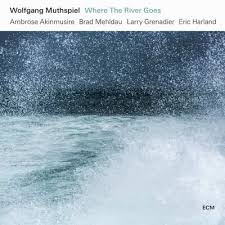
Wolfgang Muthspiel – Where the River Goes
ECM Records
★★★★☆
Wolfgang Muthspiel’s Where the River Goes is a spellbinding sequel to his 2016 release, Rising Grace, and once again, the Austrian guitarist gathers a dream team of collaborators—Brad Mehldau (piano), Ambrose Akinmusire (trumpet), Larry Grenadier (bass), and Eric Harland (drums). These are musicians who need little introduction, and Muthspiel’s compositions feel almost tailor-made to their abilities. Together, they conjure a sonic landscape of remarkable depth, restraint, and fluidity, where every note feels as if it’s been plucked directly from the river of time.
The album opens with the title track, “Where the River Goes,” a piece that flows with a sense of quiet inevitability. Muthspiel’s nylon-stringed guitar work is understated, threading through Mehldau’s prismatic harmonies and Akinmusire’s breathy, introspective lines. The group takes its time here—this is music that breathes, a slow exhale in an often hyperventilating world.
Tracks like “For Dancers” and “Panorama” are more rhythmically charged, showcasing the elasticity of Harland’s drumming and Grenadier’s lithe basslines. Harland, in particular, shapes the music with a fluid sense of pulse, creating moments that seem both anchored and untethered, much like water itself.
Akinmusire shines on “Clearing,” delivering a trumpet performance that is at once mournful and defiant, his tone bending and twisting like light refracted through rippling water. Mehldau’s contribution is equally luminous, his solos weaving dense, harmonic threads that reward close listening. There is a conversational quality to his interplay with Muthspiel; their lines overlap and interlace like old friends finishing each other’s sentences.
If there’s a criticism to be made, it’s that the album’s commitment to subtlety occasionally risks veering into homogeneity. The dynamics are nuanced, yes, but there are moments where the listener might yearn for more pronounced contrasts or a sudden burst of energy. That said, this is clearly by design—Muthspiel’s approach here is more about creating a cohesive atmosphere than delivering fireworks.
The closer, “One Day My Prince Was Gone,” is a wistful and haunting finale, a meditation on impermanence that lingers long after the final note fades. It encapsulates the ethos of the album: a celebration of the journey, not the destination, of the spaces between notes as much as the notes themselves.
Where the River Goes is quintessential ECM: pristine production, contemplative compositions, and performances that balance precision with improvisational freedom. It’s an album that invites the listener to slow down, to drift with its currents, and to discover its quiet revelations on repeated listens. Muthspiel has not just charted where the river goes—he’s shown us how to follow it with grace.
Wolfgang Muthspiel – Where the River Goes
 Max Millar Music