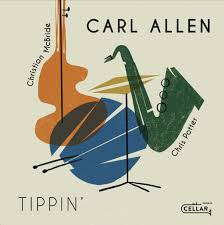
Carl Allen, Tippin’ (Cellar Live/La Reserve)
What does it mean to be “tippin’”? In simple terms, it’s when a band locks into the groove so naturally that everything just falls into place, without forcing the issue or trying too hard. It’s that sweet spot where the rhythm section is locked, the soloists are flowing, and the energy in the room is just right. And if anyone embodies that feeling, it’s Carl Allen. A seasoned drummer whose history includes stints with the likes of Freddie Hubbard and the Christian McBride Big Band, Allen’s Tippin’ delivers this essence with every beat.
This album marks Allen’s return to the spotlight as a bandleader after a two-decade hiatus, and it’s well worth the wait. The trio format here is stark—no piano or guitar—just bass, drums, and the always fiery Chris Potter on tenor and soprano saxophones and bass clarinet. The setting, bare-bones as it is, recalls the heyday of Sonny Rollins’ iconic trio recordings, with a slight nod to the more contemporary flavor of Potter’s work in Jonathan Blake’s Trion and the ECM sessions of Steve Swallow’s Damaged in Transit. For those who dig that sound, Joel Frahm’s recent The Bright Side and Lumination should be next on your playlist.
The music on Tippin’ is all about urgency and freedom, captured in a spontaneous, live-in-the-studio vibe. According to Allen, the trio didn’t rehearse much—everything was laid down in a single five-hour session, and it shows. The tunes themselves are drawn from the modern jazz canon, but with a fresh approach that breathes new life into them. Among the highlights are Freddie Hubbard’s “Happy Times,” a tune that moves at breakneck speed, and Lenny White’s “L’s Bop,” which Hubbard also recorded. There’s also James Williams’ haunting “Alter Ego,” a tribute to the late pianist, and Kenny Barron’s “Song for Abdullah,” a beautiful moment where McBride bows while Barron himself guests on piano. The trio even takes on Pat Metheny’s “James,” a piece that’s as lush as it is cerebral, and the classic “Parker’s Mood,” where Allen guides the group through the original “grown-up” tempo—a masterclass in groove and restraint.
But this isn’t just about the song selection—it’s about the collective chemistry. Allen, McBride, and Potter create an atmosphere that’s palpable throughout the recording, one where the musicians trust each other to navigate both the written material and the unspoken spaces in between. No one is showing off here, no one is pushing for a moment in the spotlight. Instead, it’s the sound of seasoned musicians who have found their collective groove and are content to live in that zone, tippin’ to the rhythm of the moment.
Tippin’ is a deep, breathing record that allows the pulse of jazz to unfold naturally—both timeless and immediate. A triumph of subtlety, mastery, and swing, it reminds us of what makes live jazz so thrilling. This is a trio that knows how to get in the pocket, and when they do, they truly tip.
Benjamin Lackner – Spindrift (ECM)
Benjamin Lackner’s Spindrift is an album that feels like it’s been sculpted in the quiet spaces between notes, a masterclass in understated sophistication and restrained lyricism. The album features a remarkable cast of players: Lackner on piano, Mathias Eick on trumpet, Mark Turner on tenor saxophone, Linda May Han Oh on bass, and Matthieu Chazarenc on drums. Recorded in March 2024, it’s a record that emphasizes nuance and interplay, making every moment feel essential.
Lackner’s compositional approach offers an elegant setting for the band to explore and stretch, each member given the space to shape their own narrative within the broader ensemble context. And speaking of Turner, though American, his approach has long distanced itself from the post-Coltrane or Brecker schools, favoring a direction more akin to Warne Marsh’s cool, cerebral lines. His tone here is characteristically calm yet full of intent, always aware of the larger picture but unafraid to inject subtle flashes of tension when necessary. This is where Lackner’s vision is most pronounced—by framing Turner’s often airy, introspective voice within rich harmonic landscapes, he allows the saxophonist’s voice to float freely, free from the constraints of aggressive post-bop expectations.
Mathias Eick, for his part, brings a similarly reflective and lyrical touch to the ensemble, albeit with a more expansive color palette. While known for his more forceful work with Jaga Jazzist and Motorpsycho, Eick’s trumpet playing on Spindrift aligns closely with the kind of airiness and introspection we often associate with Kenny Wheeler. His lines glide with the grace of a bird in flight, while still carrying a certain depth—evoking emotion without sentimentality. The tension between Eick’s airiness and Turner’s restraint creates an almost conversation-like dynamic, one that allows the interplay to shimmer throughout the record.
At the heart of this collective, however, is Linda May Han Oh’s bass. It’s hard to overstate the impact of her presence—her vibrant, energetic touch provides the album with both rhythmic foundation and melodic richness. Whether she’s providing the pulse or weaving between the lines of the horn players, her contributions are integral, adding a sense of dynamism that is often subtle yet deeply felt. Han Oh’s ability to provide both a steady anchor and a source of energy is a defining characteristic of the album’s tone.
Drummer Matthieu Chazarenc is a steady force behind the kit, never intrusive but always precise, grounding the ensemble with a sense of restraint. The drums support but never overwhelm, creating a subtle but essential framework for the music to breathe. His sense of time feels elastic, allowing the melodies to float just above the rhythm in a way that enhances, rather than stifles, the group’s collective expression.
What’s most striking about Spindrift is how Lackner has crafted an ensemble with such palpable chemistry, allowing each voice to shine individually while maintaining the integrity of the collective sound. The music is dense but never crowded, allowing each player to explore their space without feeling hurried or rushed. Each tune is a carefully constructed conversation, where every phrase feels like a reflection of the one before it, and the one yet to come.
In all, Spindrift suggests that Benjamin Lackner has created an ensemble of great potential—an aggregation of exceptional voices and talents, all drawn together by a shared vision of musical expression that’s both intimate and expansive. It’s the kind of album that grows with every listen, its nuances revealing themselves slowly, like the ebb and flow of the sea the title evokes. The possibilities for this group seem boundless, and it’s exciting to think where Lackner might take them next.
Dave Holland & Lionel Loueke – United Vol 1 (Edition)
The pairing of bassist Dave Holland and guitarist Lionel Loueke is an inspired one. With United Vol 1, their first collaborative release, the duo presents an album that balances deep musicality with a sense of spontaneous exploration. From the opening note, it’s clear that this is a partnership that thrives on contrast and complementarity, with Holland’s grounding, powerful basslines setting a rich foundation for Loueke’s intricate guitar work and ethereal vocals. The album, though not revealing its recording date, feels fresh, vibrant, and alive with possibility.
The standout track Tranxit effortlessly captures the duo’s chemistry. The Afro-funk and Latin influences are palpable as Holland’s bass unspools a fast, weaving improvisational passage, while Loueke’s rhythm guitar dances with rapid, almost breathless strumming. The syncopation and rhythmic drive never lets up, as if both players are in a race to the finish line, their energy constantly shifting but never losing its pulse. The result is an infectious, high-octane groove that draws the listener in, full of momentum and playfulness.
On Celebration, Loueke moves into familiar terrain, his guitar lines recalling the jagged yet joyful phrasing of John Scofield. In this piece, the tension between Loueke’s sharp, jazzy guitar fragments and Holland’s resonant, deeper bass figures creates an engaging push-pull dynamic. There’s a sense of joyous struggle between the two players, as Loueke’s bright, angular melodies spar with Holland’s deep, undulating tones, only to find their way into a mutually satisfying groove by the track’s conclusion. It’s the type of musical conversation that highlights both artists’ immense skill in both solo and ensemble settings.
Life Goes On takes an unexpected turn, with echoes of Bill Frisell’s country-tinged compositions filling the space. Loueke’s guitar tones take on a more twangy, earthy quality, while Holland’s bassline adopts a steady, understated rhythm, providing a perfect contrast to the more expansive and open-ended phrasing of the guitar. The piece exudes a warmth and reflection, offering a kind of serenity before the more complex interactions of the rest of the album.
Perhaps the most striking track is Humanism, where Loueke’s vocals—sung in French—add another dimension to the duo’s sound. The combination of Loueke’s edgy guitar figures, his exultant vocalizations, and Holland’s graceful basslines forms a vivid, emotionally charged landscape. It’s a blend of joy and complexity, the exultant mood tempered by the song’s intricacies, revealing the delicate balance between humanity and abstraction. The song’s shifting textures and rhythmic ideas provide a vivid sketch of the intentions of the set, aptly titled United. It’s a celebration of collaboration, where the individual voices of both musicians emerge, collide, and ultimately coalesce into something transcendent.
What makes United Vol 1 particularly engaging is the way these two masters of their craft draw upon a wide range of influences—from Afro-funk to contemporary jazz to more introspective, folk-inspired moments. Holland’s bass is ever the anchor, sturdy and expansive, while Loueke’s guitar and voice provide an agile, flowing counterpoint. The music is full of light and dark, its moods shifting fluidly between exuberance and introspection. Each track offers a glimpse into the artists’ broad musical vocabularies, while the overarching theme of unity—both in sound and spirit—remains steadfast throughout.
In the end, United Vol 1 is more than just a collaboration; it’s a harmonious meeting of two musical minds that’s full of rich textures and complex emotions. Holland and Loueke have created something deeply musical, yet always accessible—a dialogue that feels both intimate and universal. With the promise of a second volume on the horizon, it’s clear that this partnership has a great deal of untapped potential, and it will be exciting to hear where these two take it next.
 Max Millar Music
Leave a comment