All Blog Posts

  • Two Tenor Titans

    Two Tenor Titans

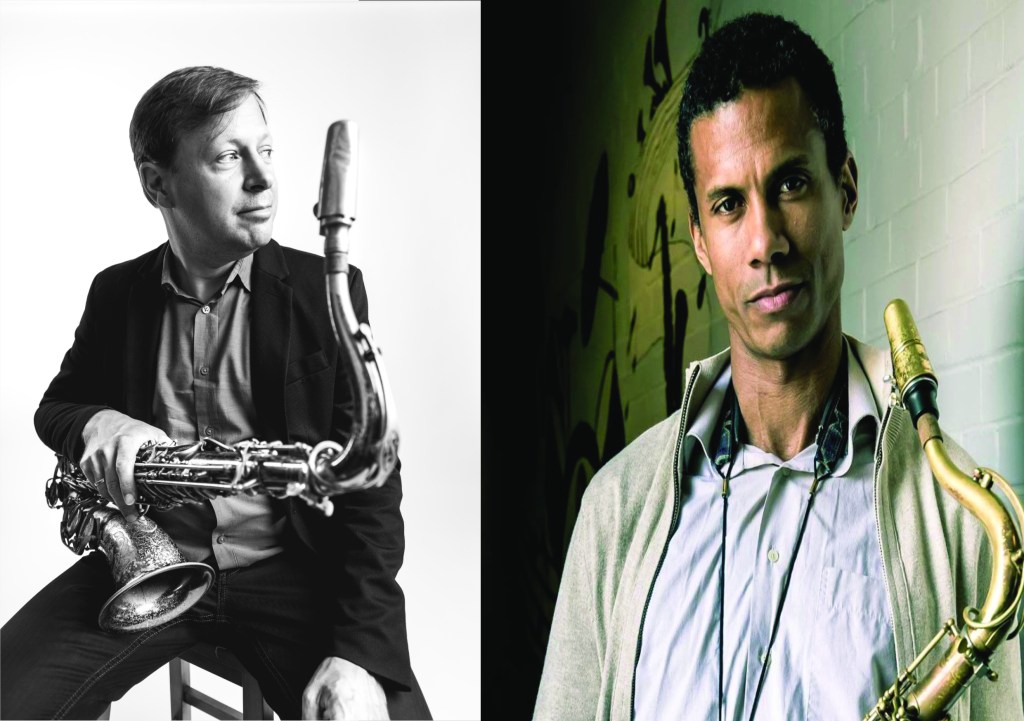
    Chris Potter and Mark Turner: Two Titans of the Tenor Saxophone

    When discussing modern jazz saxophone, the names Chris Potter and Mark Turner loom large, their styles as distinct as their paths to prominence. Both emerged in the 1990s and quickly established themselves as paragons of technical mastery and creative ingenuity. Yet, their approaches to improvisation, their artistic priorities, and the influences they’ve passed on to subsequent generations could hardly be more different. Together, they’ve reshaped the landscape of jazz saxophone, setting a dual template for innovation that continues to inspire younger players.

    Chris Potter: Virtuosity and the Power of the Line

    Chris Potter is often described as a prodigy-turned-maestro. By the time he joined Red Rodney’s band at 18, his immense technical facility was already drawing attention. Potter’s playing is marked by a seemingly endless flow of ideas, a relentless pursuit of motion and development. His lines are complex but grounded in the jazz tradition; one can hear echoes of Sonny Rollins’ muscular phrasing, Coltrane’s sheets of sound, and Michael Brecker’s virtuosic articulation.

    Potter’s improvisational style prioritizes momentum. His solos are like journeys through dense harmonic landscapes, building tension with intricate chromaticism and cascading arpeggios. He uses odd meters and shifting rhythms with ease, as heard on albums like Gratitude and The Sirens. His technical mastery allows him to execute ideas with astonishing clarity, often leaving listeners marveling at the sheer physicality of his playing.

    This combination of tradition and forward-thinking virtuosity has had a profound influence on younger saxophonists. Musicians like Donny McCaslin, Melissa Aldana, and Ben van Gelder have clearly absorbed Potter’s ability to fuse technical brilliance with emotional intensity. His command of extended techniques—overtones, multiphonics, and altissimo—is now almost expected of the modern saxophonist, thanks in large part to his example.

    Mark Turner: Intellectualism and the Geometry of Sound

    Mark Turner occupies a contrasting space. While Potter’s playing might evoke a roaring river, Turner’s style is more akin to a Zen garden—spare, meditative, yet deeply intricate. Turner’s sound is rooted in the airy, pianistic approach of Warne Marsh and Lee Konitz, but he pushes this lineage into new conceptual territory.

    Turner’s improvisations are architectural. His use of wide intervals, counterpoint, and harmonic abstraction creates a sense of verticality; the listener feels as though they’re navigating a vast, open structure rather than a linear narrative. On albums like Ballad Session or Lathe of Heaven, his tone—soft, almost dry—offers a sharp contrast to Potter’s robust sound. Turner is less interested in the overtly virtuosic than in developing thematic material with precision and patience. His improvisations often feel like intellectual puzzles, where the resolution emerges gradually and with great subtlety.

    Turner’s influence is perhaps more niche but no less profound. Players like Ben Wendel, Walter Smith III, and Logan Richardson have adopted elements of his intervallic approach, his interest in non-standard chord progressions, and his commitment to restraint. His refusal to rely on flashiness has encouraged a generation to explore depth over spectacle, making him a beacon for those who value conceptual rigor.

    Two Paths, One Legacy

    Comparing Potter and Turner highlights a fascinating dichotomy in modern jazz. Potter’s approach is rooted in kinetic energy, in the momentum of the line and the thrill of harmonic complexity. Turner, by contrast, seeks clarity and space, prioritizing thematic development and harmonic exploration. Both players are firmly connected to the jazz lineage—Potter through Coltrane and Brecker, Turner through Marsh and Konitz—but they’ve extended it in ways that have fundamentally altered how the tenor saxophone is played and conceived.

    The dual influence of Potter and Turner on subsequent generations is undeniable. For young saxophonists today, these two figures represent complementary ideals: the technical brilliance and drive of Potter, the intellectual depth and abstraction of Turner. It’s no surprise that many contemporary players aim to synthesize elements of both. Ben Wendel, for example, draws on Potter’s rhythmic energy and Turner’s contrapuntal sensibility, while Walter Smith III balances thematic development with virtuosic flourishes.

    Their Own Influences

    It’s worth noting how Potter and Turner themselves arrived at their approaches. Potter’s influences—Coltrane, Rollins, Brecker—are evident, but his interest in other genres, from funk to folk, has broadened his palette. Albums like Underground showcase his willingness to incorporate electric instruments and groove-based textures, echoing Brecker’s experiments with fusion but with a more contemporary twist.

    Turner, on the other hand, has often cited Marsh and Konitz as foundational influences, but his fascination with classical music—particularly the contrapuntal works of Bach—sets him apart. His compositions often resemble chamber pieces, blurring the line between jazz and contemporary classical music.

    Two Poles of Modern Saxophone

    Chris Potter and Mark Turner have charted two poles of the modern saxophone, each offering a model of what jazz can be in the 21st century. Potter’s athleticism and harmonic daring are a reminder of the power of sheer momentum and technical command, while Turner’s introspection and precision point toward the value of patience and abstraction. The influence of these two titans is everywhere in contemporary jazz, their contrasting approaches serving as a dual compass for the current and future generations of players. Whether through the explosive energy of Potter or the quiet profundity of Turner, the tenor saxophone continues to speak in new and compelling voices, thanks in no small part to these two remarkable musicians.

  • An Interview with Brad Mehldau

    An Interview with Brad Mehldau

    by Max Millar

    Max Millar: Brad, first off, let me just say what an absolute honor it is to sit down with you. Your playing has shaped how I approach the piano, and I know countless others feel the same way. Thanks for taking the time to talk.

    Brad Mehldau: Thanks, Max. I’m glad the music has resonated with you. That means a lot.


    Max Millar: Let’s dive in. One thing that always strikes me about your playing is your ability to layer textures—like how you weave independent melodies in your right and left hands. I think of pieces like your take on Radiohead’s Exit Music (For a Film) or your improvisations on Blackbird. How did that kind of contrapuntal approach develop?

    Brad Mehldau: It goes back to my early fascination with Bach. I’ve always been drawn to the way he could make two or three voices speak independently but still interact in a meaningful way. When I’m improvising, I’m often thinking of counterpoint—not in a strict, academic sense, but as a way to let the left hand have its own conversation while the right hand explores something else. It’s like two characters in a dialogue.

    But it’s also emotional. With Exit Music, for example, the goal was to capture that haunting melancholy, and counterpoint helps create that tension. One voice pulls you in one direction, the other in another—there’s this unresolved feeling that mirrors the song’s narrative.


    Max Millar: That’s fascinating. And when it comes to harmony, your reharmonizations are legendary. I’ve heard people describe your chords as “classical meets jazz meets pop.” What’s your process when reimagining a tune harmonically?

    Brad Mehldau: Reharmonization is where I let my instincts take over. When I hear a melody, I ask myself: What else could this melody be saying? A simple diatonic progression might work beautifully, but shifting to something chromatic or unexpected can reveal a different side of the tune.

    Take Blackbird, for instance. It’s a beautiful melody that sits perfectly over a standard folk progression, but if you add, say, a diminished chord or imply a Lydian sound, suddenly it’s a little more unsettled, even bittersweet. I think about tension and release—how the harmony can heighten or subvert what the melody is already doing.


    Max Millar: That idea of tension and release comes up in your use of rhythm too. The way you’ll play with time, stretching or compressing phrases, can be so breathtaking. How do you approach that sense of rubato and rhythmic flexibility?

    Brad Mehldau: That’s something I’ve worked on for a long time. It’s about listening and trust. When you’re playing in a trio, for example, you have to trust that the bass and drums will hold the pulse, even if you’re floating above it. And vice versa—they need to trust you to eventually resolve back into the groove.

    But rubato isn’t just about freedom. It’s about intention. If I’m stretching a phrase, I want it to feel natural, as if the melody needs to take that breath. You don’t want it to feel like a gimmick. Keith Jarrett does this masterfully—he’s always breathing with the music, even when he’s pushing it to its limits.


    Max Millar: Speaking of Jarrett, your solo playing often gets compared to his—particularly in how you build improvisations so organically. How much of his influence do you carry with you, and how do you carve out your own space in that lineage?

    Brad Mehldau: Jarrett is, without a doubt, a massive influence. His solo concerts are like these vast emotional landscapes where every idea feels inevitable, like it couldn’t have gone any other way. That’s something I aspire to—letting the music unfold naturally, without forcing it.

    But I also think about what I can bring to the table. For me, it’s about weaving in the other influences I’ve absorbed, whether it’s Radiohead, Nick Drake, Brahms, or Coltrane. Those elements are part of my personal story, and they help shape the narrative I’m telling in the moment.


    Max Millar: Your incorporation of pop and rock influences has been so important for bridging jazz with a wider audience. What draws you to artists like Radiohead or Nick Drake, and how do you translate their music into your language?

    Brad Mehldau: I’m drawn to music that feels honest, whether it’s jazz, classical, or rock. Radiohead and Nick Drake, in particular, have this emotional vulnerability that resonates with me. It’s not about genre—it’s about finding the humanity in the music.

    When I arrange a pop tune, I’m not trying to make it “jazzy.” I’m trying to preserve what makes it special while letting it breathe in a different way. With Radiohead’s Everything in Its Right Place, for instance, I kept that hypnotic, looping quality but added improvisational elements to create a dialogue with the original.


    Max Millar: Let’s talk about younger pianists. Your influence on players like Gerald Clayton, Tigran Hamasyan, and Aaron Parks is undeniable. What do you hope the next generation takes from your work?

    Brad Mehldau: I hope they take the idea that jazz is a living, evolving art form. It’s about tradition, yes, but also about curiosity and exploration. I’ve always tried to approach music with an open mind, whether it’s diving into the American songbook or exploring contemporary music.

    And I hope they see that it’s okay to let your personality shine through. Jazz isn’t about fitting into a box; it’s about expressing who you are in the most honest way possible.


    Max Millar: One last question, Brad. After everything you’ve accomplished, what still excites you about making music?

    Brad Mehldau: The unknown. Every time I sit at the piano, there’s the potential to discover something new. Music is infinite, and no matter how much you learn, there’s always more to explore. That sense of possibility—that’s what keeps me coming back.

    Max Millar: Beautifully said. Thank you, Brad, for sharing your insights. This has been a dream come true for me.

    Brad Mehldau: My pleasure, Max. Keep playing, and keep listening. That’s what it’s all about.